
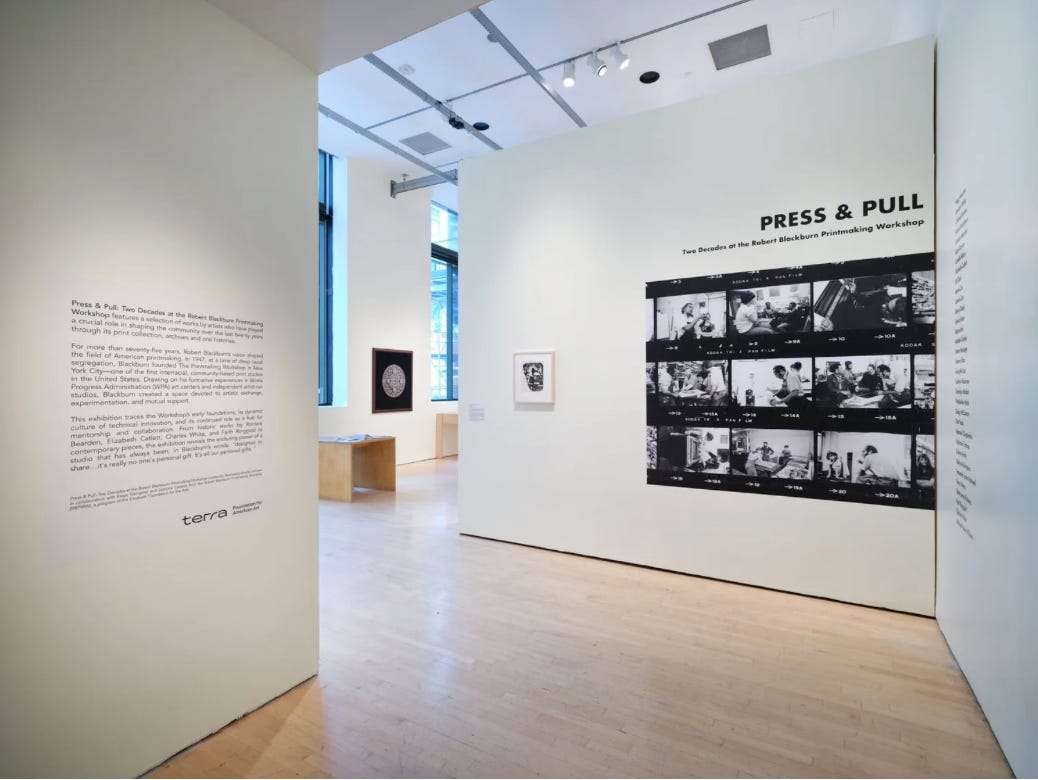
“Press & Pull: Two Decades at the Robert Blackburn Printmaking Workshop,” curated by Shameekia Shantel Johnson, in collaboration with Essye Klempner and Jazmine Catasús, currently showing at the James Gallery at 365 5th Ave, off 34thStreet, in New York City.
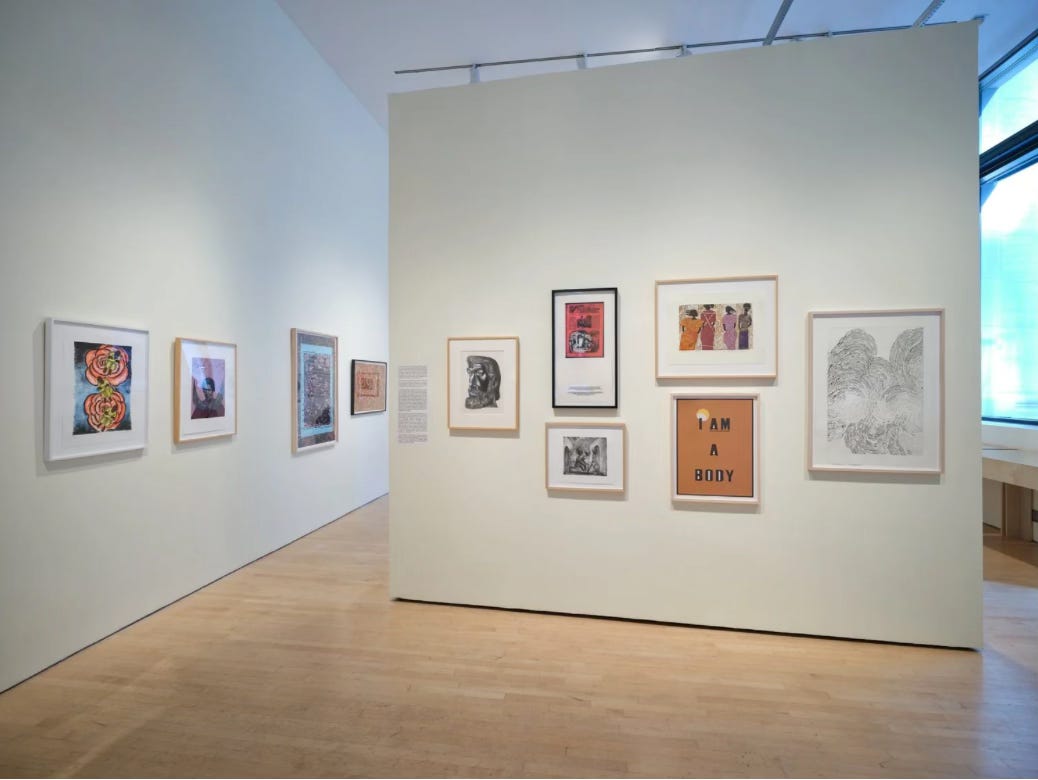
“Press & Pull” is a stunning retrospective of decades of printworks made at a community workshop founded in 1947 in New York City by the artist and printmaker, Robert Blackburn. Over the course of decades, the printmaking workshop became an artist cooperative and home to Black and women artists who were largely cast out of the mainstream art scene in NYC because of continuing forms of segregation and prejudice. In the process, the workshop brought together an extraordinary collective including Romare Bearden, Faith Ringgold, Charles White, Elizabeth Catlett, Ed Clark, Renee Cox, Maren Hassinger, Krishna Reddy, Kameelah Janan Rasheed, and Kenny Rivero, among others. Their works, pulled together in this show at the James Gallery, is a real tribute to the art of collaboration—or what I might call the techne of cooperation. More than anything, what shines through these artworks, the installation, and the printmaking workshop at 39th Street, are the deep bonds of solidarity that formed at the Robert Blackburn Printmaking Workshop in New York City over decades.
Robert Blackburn was an African American artist who grew up in Harlem and was educated and trained through community programs funded by the New Deal era’s Works Progress Administration (WPA). Blackburn started the printmaking workshop after the WPA shut down during the war, in his loft on 17th Street in New York City in the winter of 1947 with a single lithography press. Blackburn’s studio became an open workshop for other Black artists who were struggling to find community in an art world still rife with racism. The community workshop was open to everyone, regardless of race, gender, and creed, and it became a hub of artistic expression for artists who felt marginalized and had little access to other art institutions. It soon became a communal space for all types of artistic activities, including apprenticeships on different printmaking machines, open studio times, classes and workshops, and the production of print editions for artists.
What emerged was one of the first interracial, community-based print workshops in the country—and now one of the oldest, if not the oldest and longest-running community printmaking workshop in the United States. At first, it sustained itself piecemeal, but gradually evolved, somewhat organically (that never means without struggle), into a cooperative operating through membership dues. It was, I am told, a fellow artist and printmaker, Chaim Koppelman, who came up with the idea and devised the plan to turn the workshop into a member cooperative with annual dues.
In 1956, the workshop took on the formal status of a cooperative and operated, from 1956 to 1971, as an artist member cooperative. Later, in 1971, it evolved into a nonprofit organization, now under the auspices of the Elizabeth Foundation for the Arts (EFA). In 2001, the community workshop merged with the EFA and became the Robert Blackburn Printmaking Workshop (RBPMW) located at 323 West 39th Street in NYC.
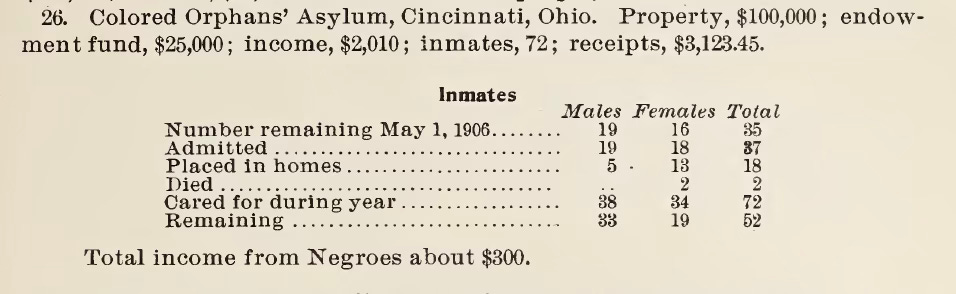
The history of the cooperative maps on remarkably, and beautifully, to the writings and praxis of W.E.B. Du Bois. Du Bois was a strong proponent of cooperatives within the Black community. At an early date, Du Bois spearheaded a voluminous and meticulous study of cooperative institutions in African American communities across the country. The study, published in 1907 under the title Economic Cooperation among Negro Americans, traced the history of cooperation as far back as pre-colonial Africa, the West Indies and the American colonies, before then recounting its history during the antebellum period, especially during the Underground Railroad. Du Bois then surveyed all of the different organizations that were based on cooperative principles within the African American community. Du Bois broke them down by type and industry, discussing everything from African American churches and schools, to Black secret societies, insurance mutuals and banks, to worker and producer cooperatives in the African American communities. He catalogued all the names of the cooperatives and gave detailed descriptions of them, including tables with monthly financial statements, receipts, payments, disbursements, number of members, etc. It is a truly remarkable compendium of historical facts. To give you a taste, here is an entry in the section on “Co-operative Benevolence: Home and Orphanages,” which opens with the following: “There are between 75 and 100 homes and orphanages in the United States supported wholly or largely by Negroes. A list of 57 follows,” including for instance:
Du Bois’ ambition was to show how much cooperation there was in African American communities, and he developed on its basis an argument for a separate Black economy of cooperatives. He wrote this up in an article published in 1935 in the journal Current History, titled “A Negro Nation within the Nation,” in which he advocated for an African American cooperative movement separate from the national economy and mainstream labor. The idea was to no longer depend on what he called “the salvation of a white God,” but instead to achieve, in his words, “a new economic solidarity.”
Du Bois confronted Jim Crow segregation and systemic racism—even within the working class and labor unions, which for the most part excluded Black persons (with the notable exception of the Wobblies)—with what he hoped would be a separatist cooperative society within the Black communities. In many ways, Robert Blackburn’s community printshop was an organic manifestation of that ambition. Blackburn turned to forms of cooperation as a way to combat segregation and exclusion. Coming together, working together in a space that was open and non-exclusionary was a way to fight against the rigid racial lines that delimited possibilities. And it was particularly productive in the printmaking context.
This is a second important point, which the “Pull & Press” exhibit instantiates in its very essence: there are inherent features to artmaking and to printmaking in particular that bend toward cooperation. Just in terms of the equipment and the printing presses alone. They are such hefty, immovable, and expensive equipment, they call out to be used in common. They are natural “common goods”—just like tractors, combines, and other agricultural equipment shared by members of producer cooperatives. The printing presses lend themselves to forms of cooperation.
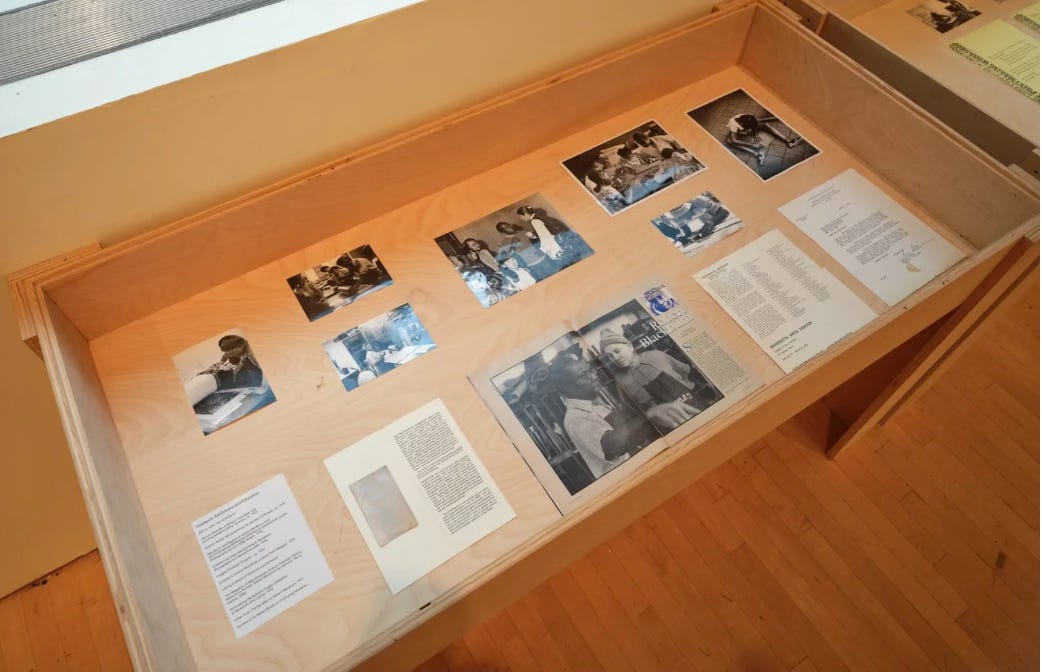
The artistic process of printmaking also calls for collaboration, for working together, often through practices that create community solidarity. Leslie King Hammond describes this in Black Printmakers and the W.P.A., where she discusses how fluid the relationships become between artists, students, and teachers in the printmaking context. “Roles freely shifted or merged, as teachers and students explored new technologies together” and the “rapid exchange of technical information and the relentless exploration of the various print media” deconstructed the different roles “in the excitement of the work.” One can witness this almost in livestream in the photographs, oral histories, and other documents at the ‘Press & Pull” exhibit.
Plus, the artistic spirit is often driven by values like creativity and imagination, rather than the profit motive—at least for many artists and certainly those who were converging on Blackburn’s community workshop.
It is those organic forces that pushed the Robert Blackburn Printmaking Workshop to become a cooperative with member fees, which is a simple organizational structure—and this is the third important point. Cooperatives, like the workshop, are straightforward and easy to form. They depend in part on membership dues. The members then own the enterprises and govern the organization through democratic principles, one person one vote. In the case of the community workshop, they effectively become the worker-owners of the entity.
Today, the printshop is a nonprofit, but the way it functions could work as well as a cooperative. There continue to be member fees. About a quarter of the revenues of the workshop are from member fees. About a quarter of the revenues are from classes and workshops which are being offered at the printshop; another quarter from contract printing and the sale of prints that are made at the workshop; and another quarter from contributions and donations. (There are also publications, exhibits and events as well). All of that could easily be organized as a cooperative—as it was from 1956 to 1971.
One final point. We are now living through a period of heightened exclusions, I would say—increasing exclusions of minorities, of African Americans with the attack on critical race theory, on diversity, on DEI, heightened attacks on gender, on women and on transgender persons, especially acute attacks on immigrants and any non-white-appearing citizens, continuing attacks on Leftist professors, on those who oppose fascism, on anyone who would dare speak of solidarity in these dangerous times.
One of the ways to confront these exclusions and to protect ourselves in these times is precisely to form cooperatives, collaborations, collectivities that promote solidarity and create economic sustainability. The practices that built the Robert Blackburn Printmaking Workshop are precisely what we need to draw on today to create more cooperation in society, to govern ourselves democratically, to set our own rules and standards, to sustain ourselves economically. I do not view this as an exclusive proposition. I am not suggesting an isolationist or a separatist agenda, but rather a form of worldbuilding through solidarity, one panel within a larger political strategy of trying to transform the world.
What is so remarkable is that there are so many collaborations and so much cooperation all around us. We are surrounded by solidaristic efforts. All we need to do, really, is to see them. In the James Gallery, at the “Press & Pull” exhibition, we are in the midst of it, ensconced in cooperation. And there are other forms of cooperation that surround us all the time, mutual aid efforts, co-op food stores, cooperative housing, worker coops and mutuals, all around us.
What I argue for in my book Cooperation is to build on those existing cooperative forms, to leverage them, to combine them, to consciously work to build on them and bridge them, so that their collective force is greater than the sum of their parts.
I call this the creation of a new economic regime, as opposed to capitalism. I call it “coöperism,” a first step towards a transformed world. It is within our capabilities. We are already surrounded by so much of it. And we can be inspired by all the printwork that has come off the presses at the Robert Blackburn Printmaking Workshop to explore the ways we can collaborate, strengthen our communities, and give ourselves the joy and the resilience to continue fighting and struggling in moments like now.
Special thanks to everyone who came out last night to the James Gallery for an inspiring discussion about the community printshop and the idea of cooperation with the critical theorist and gallerist Kai Matsumia, the director of programming and partnerships at the EFA Robert Blackburn Printmaking Workshop Essye Klempner, the art historian Claire Bishop and political philosopher Uday Mehta, the executive director of the Elizabeth Foundation for the Arts George Scheer, the artist Craig Kalpakjian, the cooperative team from Stitches, and many more.
It is great to learn how African-American print-makers were able to, faced with discrimination, find an alternative mode of remaining active within their field not solely as individual voices but as a community. As an dance maker, I find it hopeful to read about artists working together within a cooperative model. Considering, not only racist but also socio-economic types of exclusion, I am wondering about the ways in which underprivileged artists could join new cooperations while not being able to pay the dues.
Look forward to seeing the exhibition.